Retiring Kerrville Police Chief Who Missed Deadly July 4 Flash Flood Warning Gets Standing Ovation by Mayor
Mayor Herring signaled a job well done Tuesday night at Kerrville City Council.
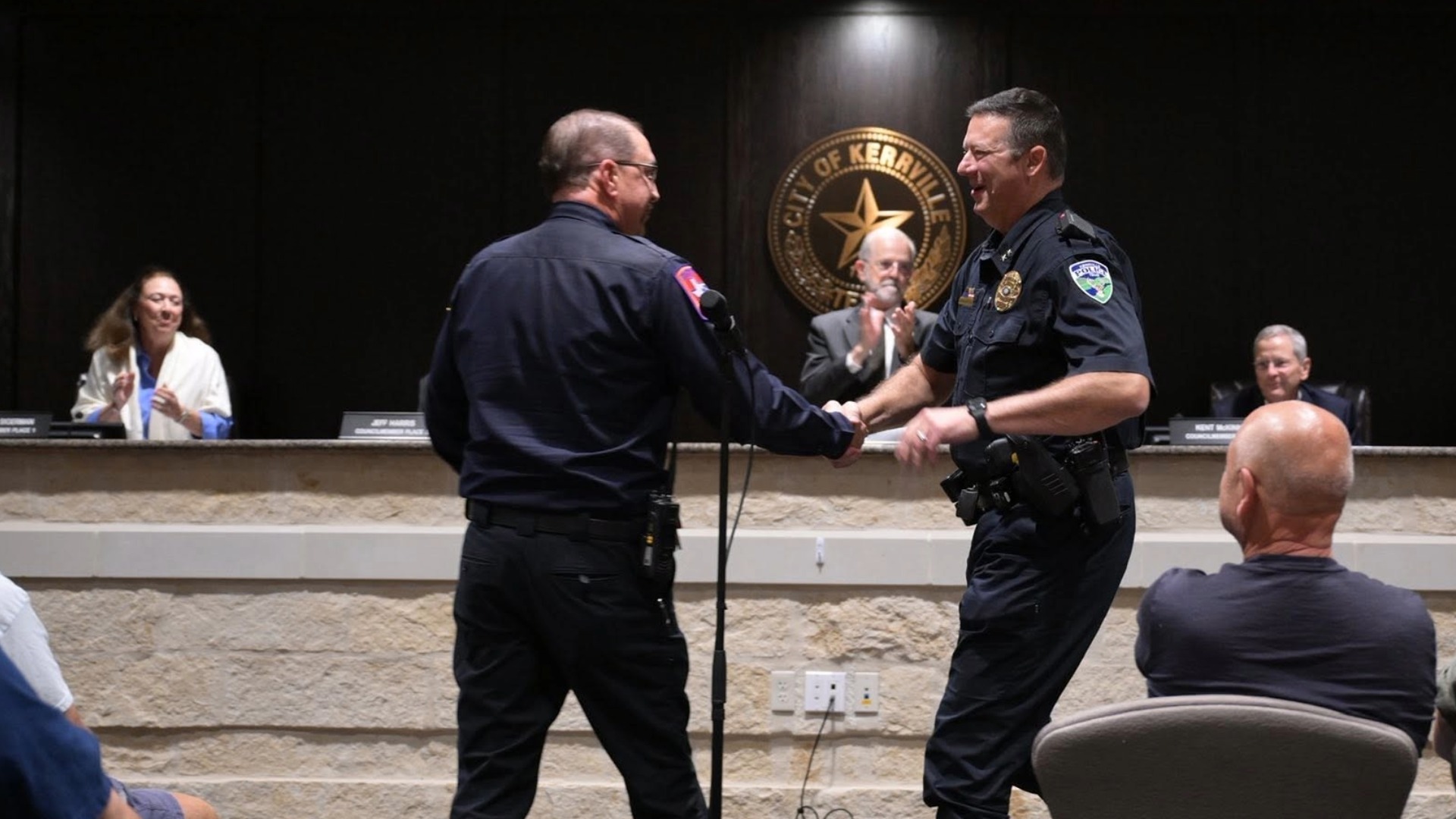
Retiring Police Chief Chris McCall was sent off with applause beneath the City of Kerrville seal — a warm civic farewell for a chief leaving after nearly thirty years in law enforcement and five at the head of the Kerrville Police Department. The city's official send-off was unreserved. In the release announcing his June 19 retirement, City Manager Dalton Rice credited McCall with "professionalism, integrity, and steady leadership," and the city folded his role in the July 4 flood response into a list of accomplishments alongside the 2024 solar eclipse and a new body-camera program.
It came on a pointed week. The July 4 flood was a mass-casualty event — 119 deaths in Kerr County, including three confirmed within the City of Kerrville itself, not counting its extraterritorial jurisdiction. The very next day, in a Travis County courtroom, parents who lost daughters at Camp Mystic were fighting just to keep the question of what happened to their children in open court.
And it leaves a question Kerrville's leaders have never answered: what happened in the hours after the first flash-flood warning reached the chief of police — the official the city's own plan made responsible for warning the public?
Warning the public was his job — on paper
Kerrville did not have to guess who was responsible for warning the public. Its own adopted emergency plan said so.
The Kerrville/Ingram/Kerr County Emergency Management Plan — the Basic Plan approved in November 2020 under the Texas Department of Public Safety's emergency-management framework, and signed by the county judge and the mayors of Kerrville and Ingram — assigns the Warning function as a primary responsibility of two officials: "the Kerr County Sheriff and Kerrville Police Chief." Together they are tasked with preparing and maintaining Annex A, the plan's Warning annex, and its supporting procedures.
The tasks the plan lists under that function are not ambiguous. They include receiving information on emergency situations, alerting key local officials, and disseminating warning information and instructions to the public through available warning systems — ensuring, in the plan's words, that the needs of the whole community are addressed — along with warning institutional facilities such as schools and hospitals.
The plan goes further. It assigns the Communications function to the Kerrville Police Chief specifically — sole primary responsibility for the communications annex and for ensuring warning systems are available and interoperable. And it assigns the Evacuation function jointly to the Police Chief and the Sheriff.
In plain terms: under the city and county's own adopted plan, warning the public, running the communications that carry those warnings, and ordering evacuations were core responsibilities of the office Chris McCall held on July 4.
The 1:14 a.m. warning
So when the first flash-flood warning reached the chief, it reached the official the plan had made responsible for getting that warning to the public.
According to text records obtained by KHOU 11 Investigates and KENS 5, Chief McCall received three CodeRed alerts that morning. The first came at 1:14 a.m. — a CodeRed weather warning relaying the National Weather Service's flash-flood warning for his location.

By 2:52 a.m., 911 calls were already coming in to a Kerrville dispatch center staffed by just two people. Over the next six hours those two would field 435 calls, McCall said in a later statement — including more than a hundred between 5 and 6 a.m. alone.
It was not until 5:02 a.m. — nearly four hours after that first National Weather Service warning — that a CodeRed message told people in the Hunt area along Highway 39 to evacuate or move to higher ground, according to city records reported by the Texas Tribune. It was Kerr County Sheriff Larry Leitha — who does not live in the alert polygon that received the 1:14 a.m. NWS warning, and so never got it himself — who had that 5:02 a.m. message sent out. How many people ever got it is another matter: CodeRed reaches only those who opt in. Minutes earlier, at 4:58 a.m., someone had texted McCall that the south fork of the Guadalupe had risen 29 feet.
McCall has offered an account of the department's actions. In an email to the Texas Tribune, he said Kerrville police were watching flood-prone areas and low-water crossings before the worst of the flooding struck, closed those roads, and began evacuating the structures first in harm's way. That account has never been laid against a public, hour-by-hour timeline of where the chief was, and what he did, between the 1:14 a.m. warning and the 5:02 a.m. evacuation message — the way Kerr County's sheriff, emergency-management director, and county judge were questioned about their own whereabouts at the state legislative hearings.
The city's defense, in its own words
Mayor Joe Herring has maintained the city did nothing wrong. He told the Texas Tribune the city's timeline would dispel any notion of a delayed response, and showed staff following the emergency plan well — "given we had no accurate warning of what was unfolding in real time."
The records complicate that claim. A flash-flood warning reached the police chief at 1:14 a.m. The 911 calls began at 2:52 a.m. And the same emergency plan the mayor invokes assigned that chief the duty to push warnings out to the public through available systems — the very kind of system that carried the 1:14 a.m. alert. Residents are left to reconcile "no accurate warning" with the chief's own CodeRed log and the plan's own assignment of responsibility.
Families fighting for the same answers
While Kerrville applauded, the families of the July 4 dead were in court.
This week, in the 459th State District Court in Austin, a Travis County judge weighed whether more than a dozen families who lost children at Camp Mystic will get a public jury trial — or whether their five wrongful-death cases will be pushed behind the closed doors of private arbitration. The families allege camp leaders failed to evacuate as the water rose; the camp wants the cases decided in private, citing a binding-arbitration clause in the registration agreement parents signed. Twenty-seven campers and counselors died there. One eight-year-old, Cile Steward, has never been found, and the proceedings run alongside a Texas Rangers criminal investigation into the camp.
Meanwhile, Mayor Joe Herring and the City of Kerrville are handing their retiring police chief a standing ovation instead of demanding a single answer — and the city's own Parks and Recreation Department has issued a public notice promoting a fireworks display for Saturday, July 4, 2026, at roughly 9:45 p.m. from Louise Hays Park, billed as part of "Fourth on the River" and the nation's 250th-anniversary celebration. Same date. Same river. One hundred and nineteen dead in Kerr County. And the city's plan is to put on a show, as if the worst day in Kerr County history never even happened.
That is what it looks like when families fight to get answers about what happened to their children: a courtroom, a judge, and a camp's lawyers arguing the public should never hear the testimony. In Austin, parents have to fight even to keep that fight in public view. In Kerrville, the council answered the same kind of questions with applause.
The questions have already been asked
None of this convicts a man by timeline alone. There may be explanations the public has not heard. But it is not for lack of asking.
On February 24, at a Kerrville City Council meeting, I, Mikaela Jade Taylor, asked Chief McCall directly. I asked the entire City Council directly. I asked Mayor Joe Herring, Councilmember Delayne Sigerman, Councilmember Jeff Harris, Councilmember Kent McKinney, and former Councilmember Brenda Hughes — a single question, on the public record: where was the chief on July 4, 2025 at 1:14 a.m., when the flash-flood warning reached him?
None of them answered. They were silent — just as Chief McCall was silent the morning of July 4, 2025, after the 1:14 a.m. National Weather Service Flash Flood Warning reached his location, the one that said:
No one answered. Not the chief. Not a council member. Not the mayor who, three months later, would signal a job well done.